
A few weeks ago, I asked listeners of The Art Engager Podcast to send me their questions about engaging visitors in museums – and the response was fantastic.
This week, I’m sharing some of those questions — and my reflections on them — in a special Ask Me Anything episode.
From how long to give people to look at artworks to building psychological safety, these are some of the frequent questions that come up when we talk about engaging visitors in museums.
Support The Art Engager podcast on Patreon.
In this post, I’m exploring a few of the questions I answer in the episode — the ones that spark the most reflection about how we engage people in meaningful conversations with art and objects.
Does everyone have to talk to be actively engaged?
The short answer is no. But it’s worth unpacking what we mean by active engagement.
In museum programmes, our goal is often equal participation — creating conditions where everyone has the opportunity to take part. But that doesn’t mean everyone has to contribute verbally. Some people think out loud; others think internally. Some learn best by talking through ideas, while others process by listening and reflecting quietly.
I’ve had participants who never said a word during a session but came up afterwards to share incredibly thoughtful insights. They were deeply engaged — just not in a way that was visible to the group.
Active engagement can look like many things: listening, observing, thinking, writing, drawing, or quietly connecting ideas. As facilitators, it helps to vary how people can participate — build in time for looking, writing, pair discussions, or non-verbal responses such as pointing or movement.
When we expand our definition of engagement beyond talking, we make space for more people to feel comfortable participating in their own way.
I explore this in more depth in 7 Ways to Create Active Engagement on Guided Museum Experiences
How long should you give people to look at an artwork?
It depends — but it’s worth thinking about what kind of looking we’re talking about.
Are we talking about that first moment when the group arrives at an artwork, or the total time spent at that stop? Because in reality, people are looking throughout the entire experience — just in different ways.
That first moment of silent or guided looking is crucial. It’s the time when participants start forming their own observations, getting curious, and becoming invested in what they see. Too often, we arrive at an artwork and start talking immediately. Giving people space to look first — even 30 seconds — helps them settle into the experience and start noticing details for themselves.
Looking can take many forms. It might be done individually, in pairs, or as a group. It can involve movement, props like viewfinders or magnifying glasses, or even writing and drawing. You can guide the looking, or invite participants to notice what draws their attention.
The key is not to skip this step. Those first few moments of focused observation are what anchor the rest of the discussion and set the tone for the whole experience.
How do you build psychological safety with groups that already know each other?
When a group already knows each other — like a class of students or colleagues — they bring their own dynamics with them. Friendships, hierarchies, rivalries, and group roles are already in place before the session even begins.
That can make creating psychological safety a little trickier. Unlike with groups of strangers, where everyone starts fresh, these participants are often more concerned about what their peers think than what you, the facilitator, think.
I like to think about psychological safety in two parts: the expectations you set at the beginning, and the behaviour you model throughout the programme.
The introduction is your chance to set the tone. You might share simple guidelines for how you’ll work together — that all observations are valued, and that there are no right or wrong answers. But what really matters is how you model this as the session unfolds.
Show genuine curiosity, validate contributions warmly and specifically, and create low-stakes ways to participate — working in pairs, using movement, or inviting non-verbal responses. These moments help participants feel comfortable taking small risks.
If you see dismissive reactions or mockery, redirect gently but clearly: “We’re building on each other’s ideas here.” Over time, those consistent cues from you help the group understand what kind of space this is — one where curiosity, respect, and openness are encouraged.
I’ve also written about building psychological safety on guided experiences if you’d like to explore that in more depth.
Continuing the conversation on visitor engagement
These are just a few of the questions I explore in this special Ask Me Anything episode. I also talk about managing challenging moments, deciding when to share the artist’s perspective, and my own journey in shaping the Thinking Museum® Approach into a book.
These are the kinds of questions that come up often when we think about engaging visitors in museums and designing meaningful, inquiry-led experiences..
If you enjoy this format and would like to hear more episodes like it, let me know — perhaps we’ll do another Ask Me Anything next year.
You might also enjoy my post on taking the fear out of inquiry-based teaching in the museum.
🎧 You can listen to the full episode above or wherever you get your podcasts.
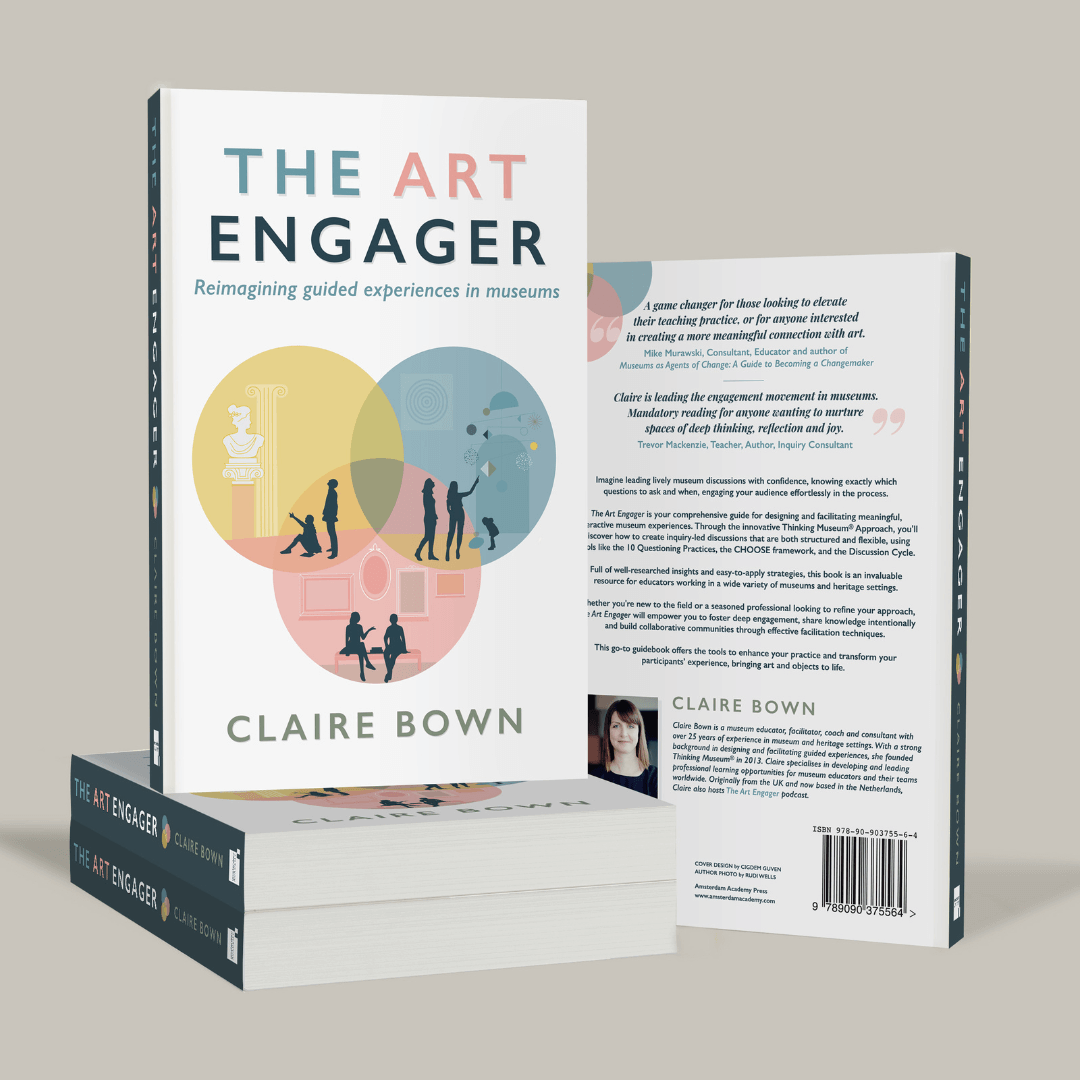
The Art Engager: Reimagining Guided Experiences in Museums
Whether you’re new to the field or a seasoned museum educator looking to refine your approach, The Art Engager is your go-to guidebook for creating the ultimate visitor experience.
Full of well-researched insights and easy-to-apply strategies, this book is an invaluable resource for educators working in a wide variety of museums and heritage settings.